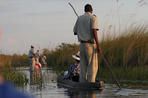
The makoro has become the iconic symbol of the Delta and is a popular way for visitors to explore the Okavango while on safari.
Originally, the only form of transport for fishing or transporting people and goods around the channels, these canoe-like vessels, approximately 20 feet or 6 meters in length, used to be crafted from tree trunks, which were painstakingly hollowed out using hand-tools.
However timber ultimately rots, and results in more trees having to be cut down, a practice which is not environmentally sustainable.
So, in keeping with the times, the modern makoro is constructed from molded fibre-glass. Durable, long-lasting and environmentally friendly, it still maintains its character - the serene, dream-like gliding through the papyrus waterways will leave a lasting impression on you.
The mokoro usually carries one or two passengers, while the boat-man stands at the stern using a long pole called a "ngashi", to pole or push the mokoro forward. Local boat-men are able to move with considerable speed and maneuverability as many have perfected this lifelong skill. The skilled locals who operate the mokoro are commonly known as 'Polers'.It was commonly agreed upon, that only certain trees should be used in their construction. The trees should be older and straight for the desired buoyancy and shape to be achieved. Jackalberry Trees, Sausage Trees and Mangosteens were some of the preferred choices used in the crafting process. The long branches of Terminalia trees are used to fashion the poles.The trunks of these trees were hollowed out with tools such as hatchets. However before the introduction of metal implements, people made use of controlled fires to hollow out the trees. The burnt wood was then chopped away with a curved chopping blade called an adze, until enough was removed so that the boat became buoyant.
The last phase of the building process demanded that the boat be crafted to create an elongated and streamlined shape with distinct points at the bow and stern.
While the demand for mokoros has steadily increased over the years in Botswana, certain problems arose concerning their production and the impact it has on had the environment. Although the Delta region is more than able to compensate for the amount of trees needed to make mokoros, the fact that only older trees are preferred, has in turn had a specific impact on this environment.
As such, tourism in the Okavango Delta promotes the use of fiberglass mokoros, which is what you will find being used by all the Delta camps and lodges today.
The mokoro excursion is a very popular activity in the Okavango Delta among guests who travel to Botswana. It is an opportunity to fully experience the sounds and sights of nature without running the risk of scaring off animals with a motor and is thus a highly recommended expedition for photographers. Guides that command mokoro are highly knowledgeable about the environment and as such these trips are considered safe and enjoyable.Some people describe a mokoro trip as one of the most peaceful experiences they have had. Imagine gliding through water that mirrors the sky above, brushing past reeds which are home to tiny brightly colored frogs, and approaching an Elephant - ear deep in the water and happily munching reeds. Imagine witnessing an amazing variety of birdlife, or catching a glimpse of Lechwe or a rare Sitatunga feeding by the water.By Michael English You can only do a mokoro safari in the Okavango Delta in Botswana, where the floodplains have created a beautiful labyrinth of waterways, la...
 This 5 Day Classic Unique Wetlands Safari Package portrays 2 of Botswana's most incredible wilderness areas, both wildlife rich and scenical...